Danny Wave / Articles
Final Fantasy VII left room for my imagination, like a book

Final Fantasy VII kills it at making its world feel real, and I don’t fully know how. I have a guess, and the guess is about what the game didn’t show.
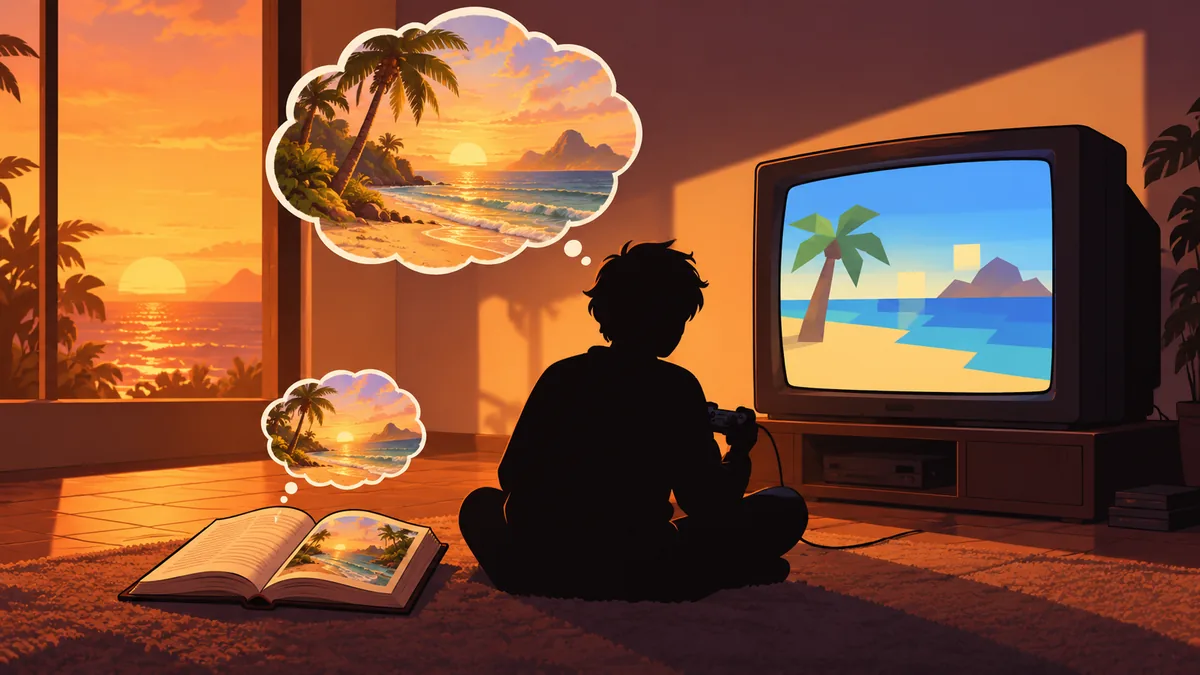
Next to the realism of a modern game, Final Fantasy VII worked with a lot less detail. Characters were built from a handful of shapes. Faces were simple. Backgrounds suggested a place more than they mapped every inch of it. The places stuck with me anyway. My theory, and it’s only a theory, is that the missing detail might be part of the reason. Because the graphics didn’t show everything, maybe my mind had the space to throw together the rest and make it feel real. The game built the foundation, and my mind did the rest.
That’s the part that reminds me of reading. A book gives you some words about a character, maybe their hair or the way they walk, and then it trusts you with the rest. You end up picturing a face nobody drew. The room, the weather, how far one town sits from the next, a lot of that gets filled in by the reader. The author sets the edges and you furnish the space.
I suspect older games sit closer to that than they get credit for. The screen hands you an outline. A shape, a color, a camera angle, a song. Anything beyond the outline has to come from somewhere, and I think some of it comes from the player.
If that’s right, it might explain the attachment. When your own mind helps build a place, the place feels a little more like yours. I feel that way about books, and I wonder if it’s part of why I feel that way about Final Fantasy VII.
The music seems to carry a lot of the load. Costa del Sol gives you a beach on screen and a bossa nova song that tells you how the beach feels, hypnotic and calming and slightly suspicious. The Oppressed, one of the early songs, made a whole new world feel somehow familiar. In both cases the game sets a mood and leaves you to take it from there.
I don’t think this splits cleanly into books and old games on one side and movies and new games on the other. Movies leave room all the time. A cut away before something happens, a sound from offscreen, a character who never says what they’re thinking, all of that asks the viewer to fill something in. Detailed modern games do it too, through a history the story only hints at or a part of the map you can see and never reach. A detailed surface doesn’t mean nothing is left to imagine.
What I’m curious about is one specific kind of room, the visual kind. How a place looks, up close. A movie or a highly detailed game usually decides that for you, and it can decide it beautifully. Final Fantasy VII decided some of it and left a lot open, partly because of how much detail the visuals of the time could carry. I can’t say how much of my attachment comes from that open space. The writing and the music might be doing most of the work, with the graphics simply staying out of the way. The book comparison keeps feeling right to me, though, and I haven’t found a better explanation for why a few flat shapes felt like somewhere I could go.
It feels like a really magical thing, and I have no idea whether anyone making the game thought about it this way. Maybe they planned for players to fill in the gaps. Maybe the gaps were just where the hardware stopped. I can’t tell from the outside.
I’m not sure the effect needed anyone to plan it. A beach made of a few simple shapes and a bossa nova song was enough to make me wonder whether Costa del Sol was a real place.