Danny Wave / Articles
Crazy Taxi figured out the hard part first

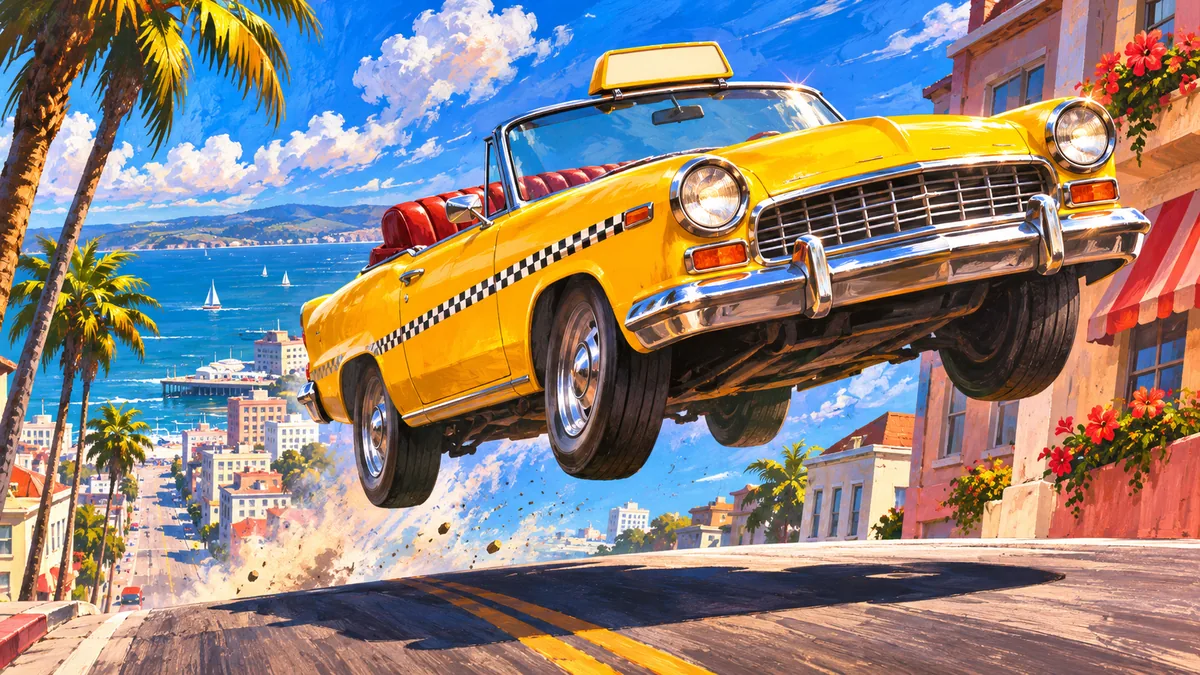
More than 25 years later, Sega’s arcade driver still feels modern, because its creators decided what had to work before they built anything around it.
The arrow in Crazy Taxi never gave you directions. It just pointed toward where your fare wanted to go and let you work out the rest, whether that meant the road, the sidewalk, or somebody’s front lawn.
I played it on the Dreamcast, and that arrow sums up the whole game for me. It knew exactly what it needed to tell you and nothing more. Most games in 2000 couldn’t do that, and plenty of games today still can’t.
So when people say Crazy Taxi was ahead of its time, I don’t think it’s because of any single feature. It’s because the people who made it got the balance right before they did anything else.
Here’s the whole game if you never played it. You pick a driver, grab a customer, and race them across a sunny, very hilly city before their patience runs out. Get there fast and they pay you well. Take too long and they jump out without paying.
In Arcade mode you start with about a minute on the clock, and good fares add more. That’s the entire loop, and it sounds almost too simple until you play it. Every fare is a tiny round. You’re never more than a minute or two from a win or a loss, and “one more try” is always right there.
This was originally an arcade game, made by Sega’s Hitmaker studio. It came out in February 1999 on Sega’s NAOMI hardware before the Dreamcast version landed in early 2000. Arcade games had to win you over in seconds and get you to drop another coin, so there wasn’t room for padding.
What’s impressive is how well that held up at home without a coin slot. Today we’d call it a game built around short sessions, the kind you play while waiting for something else. Crazy Taxi was doing that before anybody was trying to design for your phone.
I’ve been a designer my whole career, long before I started streaming, and the hardest part of any project is figuring out the one thing that has to work and protecting it. Everything else is decoration.
Crazy Taxi feels like a team that understood that completely. The driving came first. Once the driving felt right, they filled in the gaps around it.
You can feel it in the stunts. Near misses with traffic earn you money, so driving like a maniac is also how you make the most money. The game takes the thing you want to do anyway and makes it the strategy.
The city got the same care. Customers asked to go to KFC, Pizza Hut, Tower Records, Levi’s, and FILA. Today real brands in a game feel normal, but back then pulling up to an actual Pizza Hut made a cartoon city feel like somewhere people lived. Later versions swapped them out for generic shops because of licensing problems, which tells you how unusual it was.
Then there’s the music, and honestly, I’d put the sound design and soundtrack right next to the gameplay. The Offspring and Bad Religion supplied every track on the original versions. If you played it back then, you can probably hear “All I Want” just reading the name.
That wasn’t luck. Director Kenji Kanno told Game Informer that the first thing he decides on for a game is the theme song, and that the soundtrack came out of a day spent sampling music at a Tower Records in Japan. That’s the same Tower Records you could drive customers to in the game.
The music isn’t background. It sets the pace you drive at, which is exactly what a soundtrack in a game like this should do.
The Dreamcast version also had Crazy Box, a set of short challenges like bowling with your cab or popping giant balloons. Each one takes a single skill from the main game and tests it in a small, silly way. It’s the kind of challenge mode games still build today, and it was sitting there on a Dreamcast disc.
Other people noticed how well it worked. Sega patented the arcade game, including the arrow and the way it handles pedestrians, and in 2003 it sued the companies behind The Simpsons: Road Rage, saying that game copied it. They settled privately, but nobody patents a design they don’t think is worth copying.
GTA has done its own taxi missions over the years, and other games have tried their versions. None of them made me feel what Crazy Taxi did, and I don’t think they were trying to. They added a taxi to a bigger game, and Crazy Taxi made the taxi the whole game.
I haven’t gone back to it in a long time, and I’d love to, ideally on stream. Part of me wonders if it holds up. Most of me thinks it does, because nothing it relied on has gone out of style. It’s a clock, a city, a customer, and a song you can’t get out of your head.
This isn’t a hot take. I just think the people who made Crazy Taxi deserve credit for knowing what mattered and building everything around it.
That arrow never told you how to get there. It pointed you the right way and trusted you with the rest, and so did the whole game.