Danny Wave / Articles
Better Fortnite Duo Communication Starts With Saying the Useful Thing, Not the Loud Thing

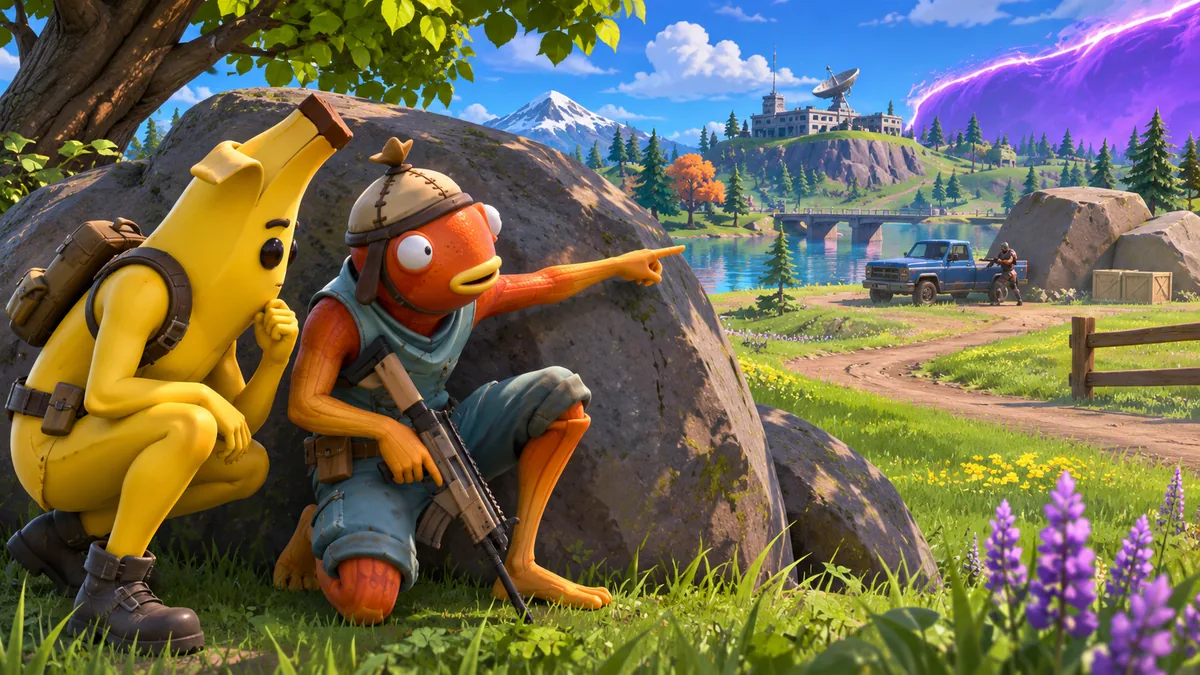
Fortnite fan art, not gameplay footage. Fortnite characters are the property of Epic Games.
Second-to-last circle. You’re crouched behind a rock that looked a lot bigger a minute ago, shots are coming in, and your duo yells, “HE’S RIGHT THERE! RIGHT THERE! RIGHT THERE!”
You’ve learned three things. Someone is somewhere. Your teammate is scared. And “there” has stopped being a word.
Most bad Fortnite duo communication comes from talking loudly in the wrong places, not from staying quiet. The fix is one habit: say what your partner can use, in this order. How many, where, what state, what you need.
“Two. Blue truck, west. One’s cracked. I’m going left, you swing right.”
That takes about as long to say as “oh my god they’re on us.” One gives your partner a plan. The other gives them your feelings, and they can’t shoot your feelings.
What a good callout actually contains
A good callout answers the questions your teammate would ask if they had time. They don’t have time. So you answer first.
A few details make a big difference.
Use landmarks you can both see. “West” works if you both read the compass. “Blue truck” works better, because nobody has to look away from the fight to check a heading. “Over there” only works if your teammate is psychic, and if they are, they’re wasting it on Fortnite.
Turn damage into a state. “I hit him for a lot” invites optimism. “Cracked” means you broke his shield, so the next hits go straight to health. It doesn’t mean he’s one shot from going down. “One-shot” means you saw the damage numbers and he’s nearly out. Only call what you actually saw, and treat it as true for a second or two. He can pop a heal or a shield while you’re still saying it, and a stale “he’s one” can walk your partner into a full-health player.
Call your own health. “I’m low, healing” might be the most underrated sentence in duos. Your partner can’t play around a problem they haven’t heard about. If you go quiet and start popping minis, they think you’re still in the fight beside them.
That last one matters even more in Zero Build, which is most of what I play. You can’t throw up a wall, so your cover is the map and your teammate’s attention. Your Overshield comes back if you stop taking damage for a bit, so “shield’s down, breaking line of sight” is a real tactical call. It tells your partner to hold the angle while you recover, instead of assuming you’re still pushing.
When it gets chaotic, get shorter
Panic is fair. Almost everyone does it. When your heart rate spikes, your brain stops building sentences and starts making noises.
The problem is that panic spreads through a voice channel. Yelling tells your partner things are worse than they look, so now two people are rushing decisions instead of one. A duo that panics together fights like two solo players who happen to share a Discord call.
So when things get loud, get shorter. “One. Roof. Low.” Three words carry more than ten seconds of screaming. Clipped, boring comms in a scary fight don’t mean you lack personality. For the person on the other end, boring is calming.
After a near miss, add one sentence: “Okay, we’re good, healing up.” That tells both of you the danger’s over, so you can stop playing at full alarm and actually think about the next rotation.
Backseat coaching is a timing problem
Say your teammate is in a close fight, mid weapon swap, and you’re watching from a ridge.
“Shotgun. No, shotgun. Why are you on the AR? Jump. Jump! Heal. Don’t heal, shoot!”
Some of that might even be right. That’s why it’s tempting. You’ve got the calmer view from the side. What you don’t have is their hands.
Mid-fight, a stream of instructions is like plugging a second controller into someone’s head. They have to beat the enemy and process your commentary in the same half-second, and there isn’t room for both.
Here’s an easy way to tell the difference:
Information describes the world. Coaching tries to drive their character.
If your partner keeps making the same mistake, bring it up between matches, as an idea. “Want to try holding high ground in end games?” lands very differently than orders shouted at someone with eleven health.
What blame costs you in the next match
Your teammate got knocked. You went down trying to revive. You’re both back in the lobby, and this is where some duos lose more than one game.
“Why’d you push?” can be a fair question. In the first few seconds after a loss, it doesn’t sound like one. It sounds like a verdict. The person hearing it gets defensive or goes quiet. Neither of those leads to better rotations.
The bigger cost shows up later. A teammate who expects blame stops making calls. They skip fights they could win. They play the next match trying not to get criticized instead of trying to win. One sentence in the lobby can quietly shape your next five games.
And if you replay most lost fights honestly, they’re shared. Sure, someone pushed. Someone else didn’t call the third party coming in behind them. Someone missed shots, and someone else was healing without saying so. There’s rarely one clean villain.
A better routine after a loss:
You’re still talking about the mistake. You’re just doing it in a way that improves the next match instead of starting the next argument.
Trust is just being predictable
The best duos feel like one player with four hands and two sets of eyes. That only works if each of you can trust what the other says.
You build that in small pieces. When you say “one” and there’s one, your partner reacts faster to your next call. When you say “I’m healing” and you are, they cover you without second-guessing. When a bad game ends without a pile-on, they’re more willing to take a smart risk next time.
This goes way past competitive play. Plenty of people queue with a friend, a sibling, a partner or somebody they met in a Discord last week, and that person might be better or worse than you. The game gets everyone into the call. How the call feels decides whether they queue again.
The good news is that none of this depends on aim. You can get better at calling numbers, landmarks and your own health in your very next match without touching your sensitivity settings.
The one thing to practice tonight
Number, place, state, plan. “Two, behind the truck, one cracked, I’m going left.”
It works when you’re calm. It works even better when you’re not, because it gives the panic somewhere useful to go. Run it out loud a few times in a casual match and it’ll start coming out on its own in a sweaty one.
Then, when the match ends, say whatever makes your partner want to hit ready again. Sometimes that’s a quick note on the rotation. Most of the time it’s “good try, next one.”
I write more about Fortnite and community play at DannyWave.com.
Follow along: watch live on Twitch · short clips on TikTok · videos on YouTube · behind the scenes on Instagram · join the community Discord