Danny Wave / Articles
Fortnite Zero Build Strategy Starts With Choosing Your Fights, Not Copying Loadouts

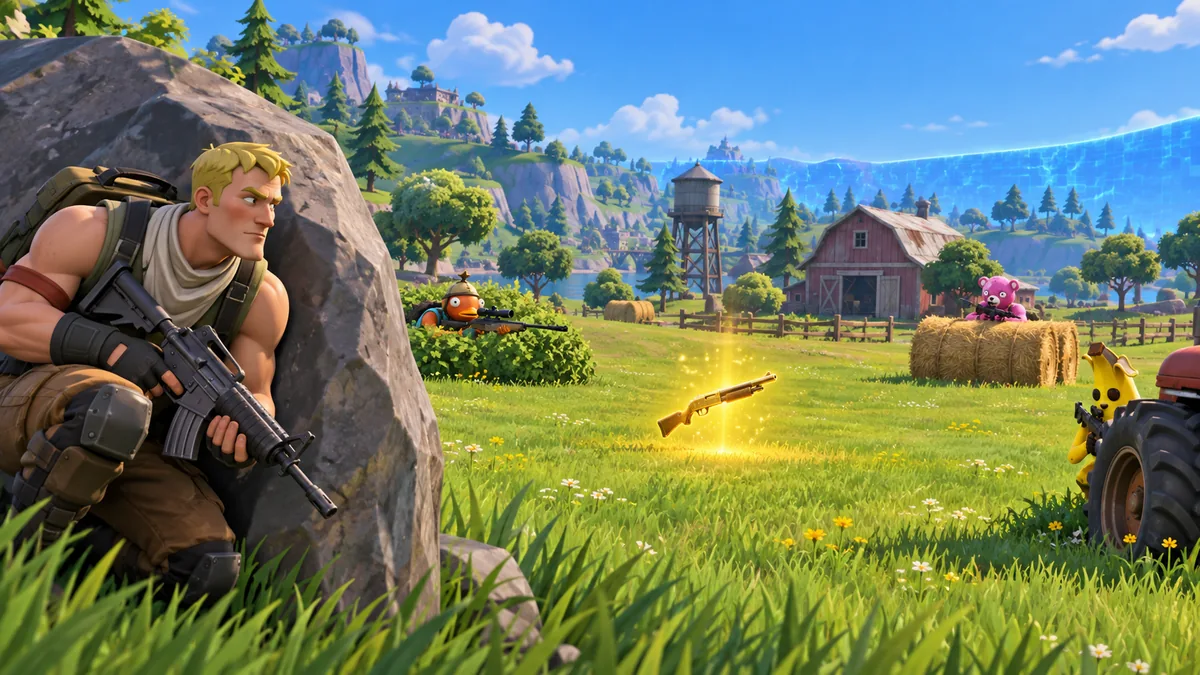
Fortnite fan art, not gameplay footage. Fortnite characters are the property of Epic Games.
You copied the loadout. Same weapons, same slots, same heals as the video. Then the same guy on the same hill dropped you in the same field, and the new gun didn’t change a thing.
Most Zero Build fights are decided before anyone shoots. Three things decide them: whether you take the fight, where you’re standing when it starts, and where you go if it turns. Get those right and an ordinary loadout wins plenty. Get them wrong and the perfect loadout just loses with better stats.
Here’s a way to make that call on purpose. There are no meta picks in here, so it still works after the next loot pool change.
Why a Bad Fight Costs More in Zero Build
In regular Fortnite, you can fix a bad spot with your hands. Caught in the open, you throw up walls and buy yourself time. Building is a very loud apology.
Zero Build takes that away. Epic’s Zero Build announcement built the mode around two ideas: no building, and a recharging Overshield that sits on top of your health.
No building means the map is the map. The rock, the hill, the doorway, the parked car you’re trusting more than you should. That’s all the cover you get, and nobody’s making more.
The recharging Overshield turns time into something you spend. Break line of sight, wait, and some protection comes back. The same goes for the player you just tagged. So a lot of fights come down to who can afford to back off and who can’t.
Why Copying a Loadout Feels Like Progress
A loadout is easy to copy. You can see exactly what a good player carried and match it on your next drop.
Good positioning is hard to copy because it mostly looks like nothing happening. Nobody clips the third party they avoided.
A loadout answers one question: what do I do once the fight starts? Plenty of eliminations come from skipping the question before that one, which is whether the fight should start at all.
So carry what you’re comfortable with. I lean toward pistols and anything with reach, because I’d rather hit someone from cover at mid range than sprint at them with a shotgun. Your comfort pick might be completely different. The decision below matters either way.
Four Questions to Ask Before You Take the Shot
Say you’re crossing a field toward the next circle. Someone’s on a ridge to your left, looting a chest, facing the other way. Your crosshair is already on them.
Before you click, run these.
1. Can I finish it? Not “can I hit them.” Can you close it out before they recover? If your first shots leave them weak behind a crest, you’ve told them where you are, and their Overshield is charging while you cross open ground. You didn’t start a fight. You started a timer, and it belongs to them.
2. Where am I standing when they shoot back? If the answer is “in a field,” they have the better spot the second they turn around. Shooting first is nice. Standing somewhere good when the reply comes is usually worth more.
3. Who hears this? Gunfire is a map marker for everyone nearby. A fight that drags on late in a match invites someone to clean up two weakened players at once. Third parties feel like bad luck. A lot of the time they’re just what happens after a long fight in a busy area.
4. Where do I go if it goes wrong? A rock, a building, the back side of a hill, a rotation path you know. If you can’t name it in a second, you don’t have one, and Zero Build won’t let you make one on the spot.
On that ridge, the honest answers are: probably not, a field, maybe everyone, and nowhere. That’s not a fight. That’s a donation. Note where they are, keep moving toward cover and reconsider from somewhere with options.
What a Good Spot Actually Looks Like
None of this means play passive. Epic pitched the mode around taking the offensive. The difference is between aggression you chose and aggression you got baited into.
Height is information first. From up high you can see who’s around before you commit, so “who hears this” becomes less of a guess.
Hard cover beats half cover. A thin fence or a small bush doesn’t hide your whole body. You want a spot where you can peek, shoot and fully disappear, because that rhythm lines up with the Overshield recharge.
Edges beat the middle. On the edge of an area, fewer directions can see you. In the middle of an open space, everyone around it can.
Waiting is a move. If you’re holding a strong spot and they have to cross open ground to reach you, let them. You don’t owe anyone a fight on their terms.
Sometimes the right call is the boring one. You have the shot and you don’t take it. It won’t make a montage, but you’ll still be in the match.
When the Fight Picks You
You won’t always get a vote. You get shot first, the storm pushes you through a bad area, or someone simply has a better spot.
Run the same questions backward. Exit first: where can you break line of sight right now? Then cover: what’s the closest thing that makes you harder to hit? Then flip the first question: can they finish you before you get there? If not, getting to cover and letting your shield come back is worth more than trading damage in the open.
Shooting back right away feels like doing something. Moving to a better spot is also doing something. It just feels worse in the moment.
How to Practice the Pause
Play a few matches where you run all four questions before every fight you start. It’ll feel slow. That’s fine. The pause is the skill, and it gets faster the more you do it.
Then play one where you assume every nearby player is a little too interested in you. Watch how fast that open-field fight stops looking good.
What Your Loadout Can and Can’t Do
A loadout you know well does help. What it buys you is wins in fights that were winnable to begin with.
How many of those fights you get comes down to everything before the trigger: the pause, the cover you picked, the exit you named, the shot you let go. None of that takes up an inventory slot, so no video can hand it to you. The mode took away building. Choosing your fights is the one thing you still get to build.
Catch me live on Twitch, clips on TikTok, videos on YouTube, updates on Instagram, and the community on Discord.