Danny Wave / Articles
How a Streamer Content Workflow Decides What Actually Deserves Tomorrow

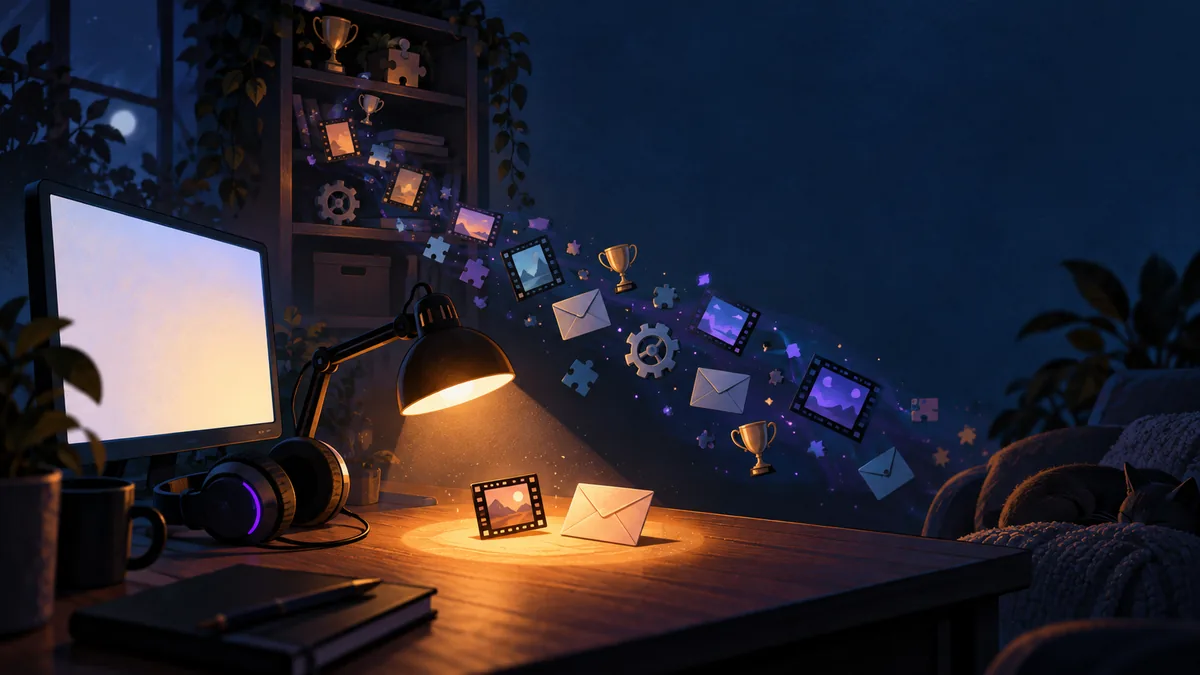
You end the stream and the room goes quiet. Then the second shift starts.
There’s a VOD with four moments that might be clips. Your Discord is full of questions. A bracket needs fixing. And there’s the thumbnail you swore you’d redo last week. You’ve got maybe an hour before your brain stops working.
Here’s how I’d spend it. Sort everything into three piles:
Do one compounding job. Keep every decaying promise. Put the rest in a scheduled block and leave it alone.
That’s most of a streamer content workflow. The rest of this piece covers why it works and where it falls apart.
Why the hour after a stream feels so expensive
Your judgment is bad right after a stream. After a good one, every moment looks like a clip. After a rough one, reorganizing your Discord roles somehow becomes the most important job in your life. Neither mood knows what actually matters.
The cost is bigger than the time, too. Choosing between twenty small, reasonable jobs every single night wears you out on its own. A lot of what drains you is deciding the same things over and over.
So don’t try to decide everything. Decide one thing: tomorrow’s compounding task. Everything else goes on a list you can read later, when you’ve slept.
Pick the clip that has somewhere to send people
A funny death is funny once. Before you spend time editing a moment, check whether it does at least one of these:
The third one is the one people skip. A Short that gets views and leads nowhere is a firework. People watch it, then it’s gone. If your channel has advanced features access, YouTube lets you add a related video to a Short, as long as it’s one of your own public or unlisted videos, so a viewer can tap through to something longer. That changes the question. You stop asking “which clip is best?” and start asking “which clip has somewhere useful to send people?” Those are usually different clips, and the second question is easier to answer.
In Fortnite, the answer is rarely your cleanest elimination. In Zero Build there’s no building and you have a recharging Overshield, so fights come down to timing. A fight where you read someone’s shield and push at the right moment shows a stranger how you think. A lucky flick shows them you got lucky. I mostly play pistols at mid-to-long range, and for that kind of play I’d look for clips where you can see why the shot was taken. If the clip only proves the shot landed, it’s a weaker pick.
Limit yourself to one properly finished clip per stream. One finished clip beats five half-done edits sitting in a folder called “CLIPS FINAL 2.”
The obvious objection is that more posts means more reach. That’s fine if you have the hours. I get about 30 minutes a day for recording and editing short-form content, and one good clip is about what fits in a budget like that. Five rushed clips don’t get you five times the reach. Usually they just don’t get posted. Your number might be different from mine, but it’s probably smaller than you think.
Community promises go bad if you leave them
This pile is easy to skip, and it’s the one most worth your tired energy.
A task decays when a real person is waiting on it. A viewer asked when the next event is. A winner hasn’t gotten their prize. A mod flagged a problem. None of this will trend. But every one of them answers a question your community is quietly asking: does this person follow through?
The work is usually tiny. The cost of ignoring it only grows. Answering a prize question takes two minutes. Explaining three weeks later why it slipped takes longer, and nobody enjoys that conversation.
In my community Fortnite tournaments, I put a bounty on myself. If you take me out, you win a skin. During the event, that’s part of the fun. Once the stream ends, it’s a prize somebody is waiting for, and the clock is running. Some winners emote on me before they claim it. I still owe them the skin.
That goes ahead of any edit. A task where someone is waiting beats a task where only your own ambition is waiting.
Admin that only looks urgent
Then there’s the stuff you can see but that isn’t on a clock. Rewriting channel panels. Tidying overlays. Restructuring Discord categories. Researching a tool you’ll probably never install.
These jobs feel productive and carry zero risk. That’s exactly why they can eat a whole evening without you noticing.
They’re still real work. I come from design and marketing, and I built my own site, so I’m not going to tell you branding doesn’t matter. It does. But it deserves focused time. The leftover minutes after a stream, when spelling “overlay” feels optional, aren’t that.
Give this pile a fixed weekly slot. When the slot is full, the rest waits. Your panels will survive another week.
A time budget you can actually write down
Here’s a structure you can adjust. Treat the times as starting points.
Right after the stream, about 15 minutes. Write down timestamps for moments worth another look. Clear any community promise that takes under five minutes. Write down tomorrow’s one compounding task. Then stop. Stopping is the hard part.
The next day, one focused block. Finish that task properly. Edit the clip, give it a clear title, and connect it to something else on your channel.
Once a week, a batch session. Go through the timestamps with fresh eyes. Cut any clips that still hold up. Work through the admin pile. Check your analytics here too, because the numbers make more sense a few days after the stream, once your feelings about it have cooled off.
The point is to stop sorting the same list from scratch every night. You won’t necessarily do more work, but you’ll waste less energy deciding.
Where this breaks
Big nights strain it. After an event or a milestone stream, every clip feels like it compounds and every promise feels urgent. Tighten up instead of loosening. Promises first, one clip second, everything else later.
It also breaks when your “one task” is secretly enormous. “Rebuild my YouTube strategy” would take a personality change. “Edit the shield-timing clip and link it to last week’s long video” is a task.
Some people really do their best editing at 2 a.m., and there’s no universal bedtime for creative work. Ask yourself whether those late sessions produce your best work or just your most work. You probably already know the answer.
Leave things unfinished on purpose
Your list will never be finished. That’s fine. Two things matter most. People who found you once need a reason to come back, and the clip with somewhere to go gives them one. People who already stick around need to trust you, and kept promises earn that. Most of the rest can wait until Thursday.
Tonight, before you close the laptop, write one line: tomorrow’s task. Tomorrow you’ll sit down already knowing what to do first.
More of what I’m working on lives at dannywave.com.
Follow along on Twitch · TikTok · YouTube · Instagram · Discord