Danny Wave / Articles
How to Run a Streaming Business Without Treating Every Viewer Like a Customer

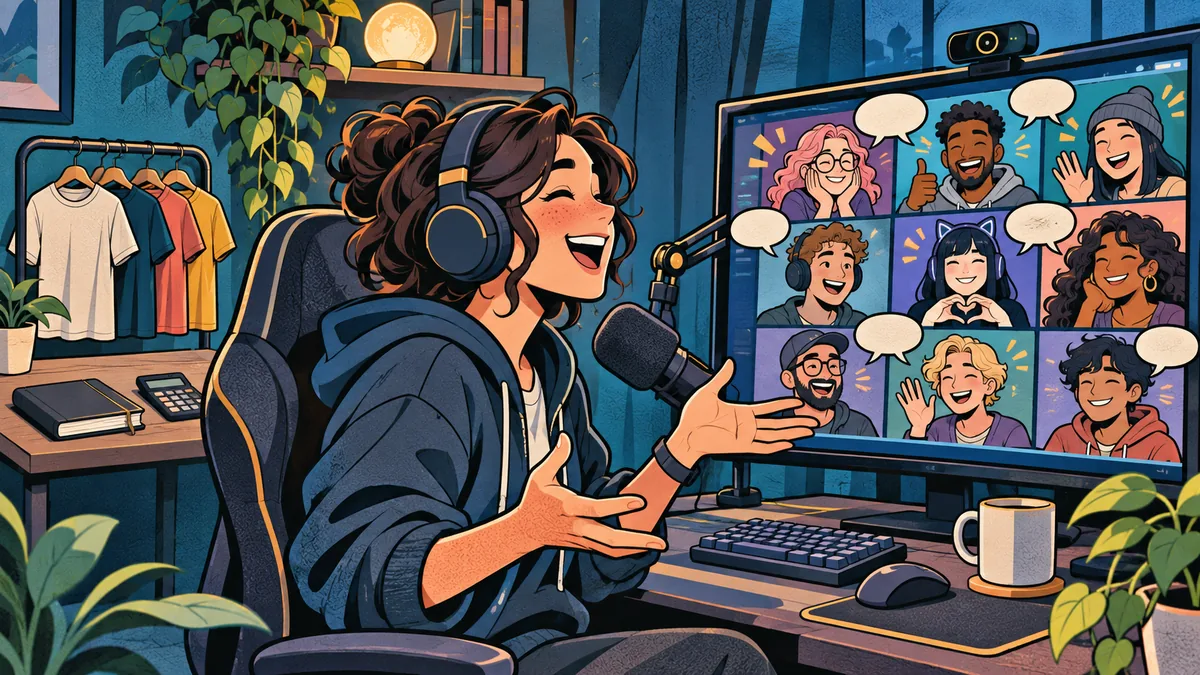
Somebody types “gg” in chat, and for half a second a small part of your brain wonders what they’re worth. Catch that moment. It’s where a lot of streams quietly start going wrong.
Running your stream like a streaming business is fine. It costs money and hours, and wanting it to cover itself is normal. The trouble starts when the business brain leaks out of the spreadsheet and into the room. The person asking about a rotation becomes a lead. Chat becomes a funnel. Viewers can feel that even when they can’t name it, and they get quieter, more careful and quicker to leave.
You don’t fix this by caring less about money. You fix it by deciding where the money lives and keeping it there.
You’re allowed to want the stream to pay for itself
Gear, software, editing, your evenings and your posture all go into this. None of that is free, and you shouldn’t feel weird about wanting some of it back.
Feeling weird about it is actually the bigger risk. Streamers who are embarrassed to ask for support tend to do it badly: long silences, then a sudden apologetic pitch that makes the whole room uncomfortable. If you’re going to ask, ask like someone who thinks the thing is worth supporting.
But “this is a business” and “everyone here is a customer” are two different sentences. Think about a coffee shop. The regular who nurses one latte for an hour isn’t a failed sale. They’re why the place looks alive enough for the next person to walk in.
Your chat works the same way. Most of the people in it may never pay you anything, and they’re still doing real work. They make chat worth reading. They clip your best moments. They bring friends. They’re the reason a newcomer sticks around past the first match. Judge them only by what they spend and you’ll slowly build a stream that pushes out the people making it good.
Sort the spaces, not the people
The cleanest boundary I know has nothing to do with sorting viewers. You sort the parts of your channel instead.
Picture a house with a small shop at the front. There’s a sign on the door, and everyone knows what happens in there. Then there’s the living room, where nobody hands you a price list while you’re sitting on the couch.
On a stream, the shop is your merch link, a sponsor segment with a clear start and end, a membership tier, a panel under the stream that just sits there. The living room is everything else: the gameplay, the conversation, community events, the Discord channels where people talk about the game instead of about you.
Having a shop is fine. Letting it spill into every room is the problem. When an ad read lands on top of a clutch moment, or a sub reminder cuts off someone’s real question, the house starts to feel like a store that happens to have a couch.
What this looks like on a normal night
Say you’re a few matches into Fortnite Zero Build. No building, Overshield that recharges, so a lot of the game comes down to when you take a fight and when you back off to reset. Someone new drops into chat and asks how you manage your Overshield in the late game without getting caught out.
You can answer that two ways.
One: you answer, then remind them subscribers get their questions answered first. Every new hello in chat comes back with a mention of sub perks. Nothing about this breaks a rule. It just turns every exchange into a toll booth.
Two: you answer properly, take the follow-up, maybe pull it up after the next fight. Between matches, at a natural break, you mention the sub button once, say what it supports and move on.
Same game, same skill, very different room. I can’t tell you which one earns more over a year. I can tell you which one I’d rather spend my evening in, and so would most of your chat.
Four boundaries that survive a Tuesday
Ideas are easy on a slow Sunday. These are the ones worth holding on an ordinary weeknight when you’re tired and the numbers are flat.
Give the ask a schedule. Pick your moments: a short mention near the start and end, a sponsor segment at a set point, a pinned panel. When the ask is predictable, people relax, because they know it isn’t coming in the middle of everything. You’ll probably miss a bit of impulse support. I think that trade is worth it, but it’s your call.
Keep the basics free. Questions about loadouts, rotations or surviving a third party are often how a quiet viewer starts talking. Put those behind a paywall and you teach chat that curiosity costs money. Paid perks can still exist. Make them extras on top, not a gate in front of the fundamentals.
Thank presence, not just payment. When you shout out the regular who’s been around for months and never bought a thing, the whole room learns what you value. People notice who gets noticed.
Read your analytics like a host. Data is useful. Just use it to find out what people enjoy, not only who might pay. If a certain kind of segment keeps people around, that’s information about your living room, and it’s worth more than another way to nudge the shop.
A quick test for community events
Events are where this line gets blurry fastest, so here’s the check I’d run on any prize: can someone win it without buying anything, and does it exist to make the event more fun?
In my community tournaments, I put a bounty on myself. A viewer who’s also a close friend suggested it, so I went with it. Take me out, win a skin. Some people take me out and then emote on me, which I’ve chosen to take as a sign they’re having a good time. That’s what a prize should do: give people a reason to play harder, not a reason to open their wallet. If you want to see how I set those up, the community tournament page has the details.
A prize that needs a subscription just to enter is a different animal. That’s a sales funnel wearing a party hat.
The bigger version of the test: strip every money element out of the event and ask whether people would still show up. If not, you don’t have an event. You have a sale with a lobby code.
“Boundaries don’t pay rent”
Fair. “Build community and the money will follow” usually comes from people who don’t have to make the numbers work, and it guarantees nothing. I’m not going to pretend there’s a formula here.
My argument is narrower. The people who choose to support you are usually the ones who already feel at home on your stream. Squeeze the living room too hard and you shrink the group of people who’d ever walk into the shop on their own. Keeping the spaces separate protects the thing that makes supporting you feel worth it in the first place.
Where you draw the line depends on your channel, your audience and how much pressure you’re under. If rent is due, your shop might be open longer hours than mine. Just keep it in the front of the house.
Do this before your next stream
Write down every place you currently ask for money: alerts, overlays, verbal reminders, panels, bot messages, event rules. Then mark each one “shop” or “living room.” Anything marked living room either moves to a scheduled moment or goes away.
It takes ten minutes, and you’ll probably find at least one ask you forgot you were making. That’s the one your chat hasn’t forgotten.
More of what I’m building lives at dannywave.com.
Follow along on Twitch, TikTok, YouTube, Instagram and Discord.